Tuesday, March 8, 2011

Preparing to be on the “outside” of the Comfort Zone

By: Paige Lindley
St. Catherine University


              During week five there was a lot of preparation for the up and coming rural home stay in Amatlan. Earlier in the program we had visited Amatlan for a day, and thus began our knowledge of this community and town, but truly had not yet had the opportunity to truly expose ourselves to more of the rural lifestyle and form bonds and attachments to those in the community. We met and discussed our hopes and fears for the home stay as well as the different cultural norms which we should try to embrace and follow as a sign of respect while in the rural community of Amatlan. The students shared many commonalities in our hopes and fears but also had differences. Due to the fact that we are all people from different walks of lives, different states and communities and have different relationships with nature and more rural lifestyles, there were varying levels of fears and excitement due to this factor. Many showed excitement to be able to do more in the outdoors, others were afraid to be out of touch with their technological sides and perhaps be “roughing” it a little more and leaving behind the “luxuries” or a more industrialized lifestyle. I put these in quotations because the luxuries in life are very objective and differ from person to person, and what one person may view as a necessity may be someone else’s luxury or even a useless undesired object or item.
            Everyone was hopeful to be involved with the community, to learn more about their lifestyles, and to form some bonds with their families and be using their Spanish. Another fear was the use of Spanish and the difficulty and awkwardness it could potentially create as well as the anticipation of what we would be eating.
This is a child whom I met during my visit. The ways in
which we interact and learn about the lives of others can change our
lives and stepping outside of one's comfort zone is important in order
to be better social workers, human beings, as well as become more
culturally competent.

Throughout our classes, we discussed micro aggressions, and the ways in which racism can occur under the radar, without even being aware ourselves. This topic is particularly interesting because it stresses us to be aware and conscious of our own prejudices which we do not always like to admit that we have, although we all possess them. As social workers it is important to be aware of these prejudices so that we do not conduct ourselves with micro-aggressions or in a prejudiced way. 

We must always be challenging our thought patterns and the ways in which we view the world and analyzing the reasons which we may feel such a way. This will help us be able to see from other people’s perspectives as well. These topics were important to address before our home stay because it helped us to be more aware of our thoughts and perspectives before going to our rural homestay, and allowed us to reflect on how those changed once we returned. It also helped us to be more “culturally competent” and conduct ourselves in a respectful manner while we were in the town, visiting different sites and living with families within the community.
            I personally didn’t have many fears before the rural home stay due to the fact that I am comfortable in this environment. Something that normally helps me feel more comforted when I am feeling stressed or anxious is keep in mind that the experience of being abroad and all of its components, is something that happens once in a lifetime. Rather than thinking about what one doesn’t have, focusing on what it is that one does have is a much healthier way to live. Time passes faster than one can imagine and is ungraspable, take advantage of each moment of breath, and be happy for the air that is borrowed. Give back to the earth appreciation, love, and life; what it gives to you.

So with this experience I began to think what are the necessities in your life? How does one remain respectful and competent in a culture foreign to one’s own as well as embrace their fears in order to experience the richness of learning from other people’s experiences and culture?


Beauty and necessity are objective. This is a plant in which my host mom uses to treat congestion and headaches. The importance of exposure to other cultures and perspectives is so
incredible important and such an enriching experience which can change
your perspectives and outlooks forever. The importance of the
environment and the ways in which people use the resources around them
is very evident , and the way in which they savored and know
about each plant and its potential uses astounded me and was a piece
of their culture I feel needs to be more important to everyone around
the world.

Thursday, February 24, 2011

The Quintessential Experiential Learning Event: Visit to Tlamacazapa

By: Lisa Rawlins
St. Olaf

I doubt that anyone in the social work group would disagree that our visit to Tlamacazapa was the most memorable part of the week. Tlamacazapa is an indigenous (Nahuat) village in the northern part of the state of Guerrero known for its palm weaving. The name Tlamacazapa, which means “people of fear,” reflects the town’s history. During the Spanish conquest of the nearby city of Taxco in the 16th century, the residing indigenous people were forced to flee, seeking refuge in what is today Tlamacazapa. Unfortunately, as we learned during out visit to the headquarters of Atzín (a community development organization that works with the people of Tlamacazapa) on Tuesday, today Tlamacazapa is plagued by numerous problems, including the high levels of arsenic and lead in the well water. The water contamination, along with the lack of food, results in widespread health problems in the community.

Student learning how to weave a canasta (basket)
On either Friday or Saturday, the social work students visited Tlamacazapa to learn more about Atzín’s work and to interact with community members. Our experiences in Tlamacazapa were simultaneously full of joy, hope, empathy, and sadness. In small groups, we learned how to fetch water from the well and tote it on our backs, climbing up steep, rocky hills in scorching heat. I am amazed that the women of Tlamacazapa do this four times a day. In addition to gathering water, at our hosts’ homes, we learned how to make tortillas by hand and also learned how to make small “canastas” (baskets) using the Tlamacazapan palm-weaving technique. Later on, we had the opportunity to meet some of the women in the quilting income-generating project. The women beamed with pride as they eagerly explained their artwork to us. Anita later commented that in the past, the women in Tlamacazapa have been much more modest and shy. She interprets their newfound confidence and sociability as a sign of empowerment and increased self esteem among the women of Tlamacazapa.

During our debriefing session the following Monday, everyone agreed that in addition to being inspired by the quilters, we were inspired by the young “promotoras” (promoters) we met. The Promotoras, are young women from Tlamacazapa who volunteer to facilitate Atzín’s programs, which include the children with special needs program, the children’s nutrition program, and an outreach program for elderly community members. Most of the promotoras are several years younger than us, and yet they are doing such important work! The promotoras taught me that anyone can make a difference, regardless of age. Their example also taught me that the most effective community development occurs through the community members themselves. As social work education literature often stresses, the client is the expert of his or her life, not the social worker. The same principle applies to community development.

In spite of all we learned about the lives of Tlamacazapans and the work of Atzín, we are still left with questions. For example, one huge question we have is “What should we do with what we have learned?” As we discussed during the debriefing session, it is much more challenging to create innovative new policies than it is to simply put band-aids on problems. Hopefully by the end of semester, we will have a better idea of our own roles in promoting social justice.

Students sharing their experiences from Tlamacazapa


Wednesday, February 16, 2011

Nuevo Semestre!!!! New Semester!!!

Welcome to Cuernavaca!!!!

A new semester has started for the Social Work in Latin America Context program. We have 16 new students from all over the U.S., from Colorado to New York City.

We are now into our 4th week and the whole group is doing great. Having a new group can sometimes be challenging because we are still getting to know each other. During the 2nd week, I had the opportunity of plan Lab Group, a weekly group run by faculty and/or students. In Lab Group the facilitator can choose any theme that connects to the academic work of the semester.

The theme of my lab group was “Why social work?” I wanted to know a little more about why my students chose social work. I told them to think of that one moment in their lives that made realize that social work was a right fit. This activity was not just another exercise to say “because I want to help”- they made bigger connections to their own experience and personal lives.

The students each had and experience that allowed them to access help whether from an agency or even a social worker. They wrote down their experience on a card and then were able to share their story with the group, of course only if they felt comfortable. They all amazed me at how comfortable they felt in sharing because we had known each other for so little time. They were all respectful and supportive of everyone’s experience. After sharing they were able to take their card and post it on a bulletin board. Then they connected their cards together to each others. Finally, they created a web consisting of the moments that brought them to Social Work and consequently, here to Cuernavaca and CGE.

Tying the string together gave it greater significance to the fact that for the next couple months we will be bound to one another. We will share many memories together and there will be times that we all will feel lost but in taking one look at our web will remind us why we are here. We are working together to understand not only ourselves but those who we will serve in the future. We are there to walk together and to have respect for ourselves and those around us.

I would like to end by sharing a quote that I find personally motivating and helps me to be both inspired and critical of my own work: "If you have come to help me, you are wasting your time; but if you are here because your liberation is bound up with mine, then let us work together." -Lilla Watson

"Why Social Work?" Students Web

-Alendi Vidal

Center for Global Education- Mexico

International Resident Advisor and Intern

Gettysburg College‘10


Wednesday, May 12, 2010

Two Kinds of Community Organizing

Kim Groen,
Bethel University

(1) Two speakers that had worked previously at CGE shared their personal past histories. They were very painful not only to hear, but to have known they had experienced and survived.

Presently both women are largely involved in Base Christian Communities that practice liberal theology. The BCC strongly focuses on acts of services, and how to aid the communities in which the resident reside. Each woman shared how they received education, participated in marches, cleaned neighborhoods, and advocated for transportation through their BCC. In a way, BCC is akin to community organization projects that many social workers partake in.

Listening to Speakers

(2) We visited a school that was created fifteen years ago out of the need and interest for the community to have a kindergarten and preschool for the children, as many parents did not want to send their children to a public school (or, school at all).

Since the school started, they now have expanded up to grade three, and hope to add a new grade every summer up until grade six. Four students are now in Universidad (University) since the school has been implemented. Before, few kids made it past third grade.

My host Mom works at this school and I had the opportunity to spend a few hours there in the morning before the rest of the students came. Many Mexican schools do not provide breakfast, but this school in particular does as many students would otherwise not have a balanced, nutritious meal.

Another way that the school is unique, is that it emphasizes the whole person. The school educates the students not only in classes such as Math, English as a second language, Spanish, science, etc. but tried to instill morals and values, emphasizing how to share, care, and get along with others.

This week has been valuable as social workers, because we have seen and learned how individuals have come together to form groups and organize in response to community needs. It’s important to talk to the people within the community to learn what the individuals´ needs are, and then use that information to organize.

Health Care System in Mexico

Kim Groen Bethel University

One guest speaker spoke about the health care system in Mexico, and problems faced by many Mexicans.

We learned about the hierarchy of the hospitals in Mexico. From previous conversations with UNAM students we had learned that the problem with Mexico’s health care system was opposite of the USA in that they had insurance for everybody, but not a quality of services, and this was reflected in the presentation.

What stood out most in the presentation to me was that in Mexico there is an emphasis on the person, in that there are services that seek to understand what is going on in an individual´s life, and how that may contribute to their symptoms. There is a strong push for traditional medicine as well as practice.

The speaker emphasized the importance of seeking feedback from the individuals in which programs are geared toward, because often great programs are designed but unused because it doed not take into account the individuals whom the program was intended for.

Wednesday, April 28, 2010

Visit to the Congress of Morelos

Hannah MacDougall
St. Olaf College

While our group experienced ups and downs we continued to be exposed to numerous speakers and classes that contributed to our expanding knowledge of Mexico.

One especially interesting trip took place on Tuesday when our Social Policy class went to theCongreso de Morelos (Morelos Congress). We first toured the building which is located near the Zocalo (main plaza) in central Cuernavaca. The building itself was formally a theater but it is now adorned with murals and statues of historical figures such as Emiliano Zapata and José María Morelos (for whom the state of Morelos was named). During the tour we received a brief history of these Mexican revolutionaries which was a nice refresher from our history classes at CGE.

Our Am. Welfare Policy Class in front of two Mexican flags at the Morelos Congress

After the tour we settled in the senate chamber where we heard from numerous speakers on topics such as education and labor.

The first woman we heard from was a member of the PRI party (Institutional Revolutionary Party) and sits on the education committee. She spoke to us about her desire to create a totally free system of education in Mexico as well as her hope of adequately representing her municipality. While our group thought her devotion to fair representation was noble, there was some speculation that her view of the indigenous population was not conducive to sufficient representation.

We also had the chance to talk about labor practices in Mexico. It was enlightening to hear from the President of the Commission on Work. It seemed that the main point he wished for us to remember was the importance that must be placed on the work of the individual. While our class was impressed by many of the labor laws in place in Mexico (such as the length of maternity leave), many of us expressed concern on the degree to which such practices are enforced.

Overall our trip to the Congreso de Morelos opened our eyes yet again to policy and practice in Mexico. We appreciated the chance to hear first hand accounts of how policy is shaped and enforced specifically in our state of Morelos.

Is skepticism of policy enforcement a universal phenomenon?

Social Work Students Go To University in Mexico City

By Anne Dutton
St. Olaf College

We spent a week in Mexico City, at the National Autonomous University of Mexico (UNAM). UNAM is a large university (238,000 students) that is home to the National School of Social Work. A couple of weeks ago we had an “intercambio” with UNAM students and to finish off our exchange we headed to Mexico City to see the school and spend time with more UNAM students and professors.

.................................
Escuela Nacional de Trabajo Social = National School of Social Work

One of the most interesting discussions we had throughout the week was about the differences in curriculum between the United States and Mexican social work programs. UNAM social work students start into the social work program from their first semester at the university and have all of their classes scheduled out for nine semesters. There are three practicums that need to be completed to graduate: one at a community level, one at a regional level and one in an area of specialization.

We visited two practicum sites during the week and the one that really stood out to me was the visit to the National Institute of Respiratory Illnesses (INER). INER is both a functioning hospital and research center for all forms of respiratory illnesses and we visited the social work students who were completing their specialization practicum in the hospital.
........................
A couple of the UNAM Social Work students gave us a tour of the UNAM

The students gave us an opening presentation which lead to a discussion about differences between health care delivery in the United States vs. Mexico. This discussion was a great follow-up to the discussion we had during the Medicaid policy presentation with the UNAM students who visited us in Cuernavaca. After the discussion, the students took us around on a tour of the INER hospital facility.

Because a lot of the problems with the Mexican health care system revolve around the quality of the care, rather than access to the care, it was interesting to see the premiere hospital for respiratory illnesses. Overall, the visit to Mexico City and UNAM was a great chance to get out of the Cuernavaca area and get to know another section of Mexico.

............................
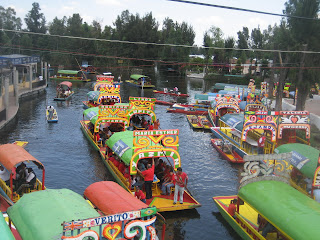
The last day of our exchange, we went for a ride down this canal in Xochimilco