Showing posts with label Study Abroad. Show all posts

Monday, May 27, 2013

New Glasses

Saying goodbye for me has always been hard, and this week was no exception to that. As a group we have been together for a little over four months. We all came here pretty much alone, maybe only knowing a few things about the people we would be spending the next semester with but now we are leaving with many bonds that will last for a lifetime. Our group has shared so much together from our cry fest in Amatlan during one of the first few weeks to our Latin dance class where we often times shared humor. When you go through an experience like we did and all we have for support is one another we become more than friends - in my opinion we become a family. This semester I was given a wonderful family to share this experience with.

This past week we all were really able to see how beneficial and just how much we got out of this whole experience living in Mexico for a semester and being in this program.  We had an assignment where we were to choose any topic that we learned about in our time here that touched us and make some sort of creative presentation to bring back to our communities back home. People wrote poems and sermons, one student painted a mural, I made a video and there was so much diversity to not only the way in which people where presenting these topics but also in the topics that people choose. For example, I chose to do my presentation on feminicidios because during my time here learning about that really moved me emotionally, while another student did a presentation on breaking down negative stereotypes of Mexico. Listening to all of these presentations put into perspective just how much we learned during our time here.

On Friday we went to our professor’s house for our last activities with one another as a group. We talked and discussed a lot about what we want to bring back with us from this experience and we made personal pledges. We also talked a lot about reverse culture shock. I never thought in a million years that I would be scared to go back home, but I have grown so much and I am such a new person from this experience that now I question whether or not I will be able to fit back into the life that I left to come to Mexico. What is one to do with so much new knowledge of the world that they live in? I think of it like this… you know how when you get new glasses or a new prescription and the first time you put the glasses on things are a little blurry before everything becomes clearer? That’s exactly how I feel about my experience in Mexico. I was given new lenses to look at my world through, going home is going to be blurry for me at first but I have confidence that everything will become much more clear. 


Graduation!
A colorful butterfly with each piece each one of us and our commitments to our community


Listening to each other's pledges to make a difference

Our group with our beatiful butterfly!


-- Zora Rabb

Friday, May 10, 2013

With Love, Laughter, and a Bit of Tears

Even before the goodbyes that will have to be said to all the friends and family that we (CGE students and staff) have created with each other over the last four months, there are many other goodbyes that I’ve had to say. We have made so many memories made since our arrival in Cuernavaca, and so much has happened that made all of us so much stronger than when we had first arrived. On this journey we have made friends, created family, and shared lifelong memories full of laughter and tears.

I arrived to Cuernavaca with no Spanish at all; it was tough navigating my way around without help from other students and staff (who I am really grateful for). But the most memorable one is at Eishel, where I intern and where I have made friends with all the residents there.

Eishel is a senior home for the Jewish community located in Cuernavaca, Mexico. A good thirty minute walk from CGE, or a ten to fifteen minute drive. In Eishel, there are always daily exercises and activities that the residents can participate in and have fun. Some of them choose to sit around outside or somewhere in the Social Room and watch TV or talk the day away about random things.

Cake to celebrate the residents with birthdays in April.
When I first arrived at Eishel, I was really nervous, because my Spanish was only basic. I have a hard time forming sentences and answering or asking questions. But with only my basic Spanish in hand, and facing head on into Eishel, I found myself easily surrounded by many wonderful elderly people who welcomed me with open arms and laughter. I was able to expand on my Spanish a bit as they teach me different words every time I’m there.

“Just listen, and ask question if you don’t understand.” That was the first piece of advice one of the residents gave me, and from then on, I tried really hard to listen. Though I may not speak Spanish well, I catch on to words from listening and from reading, which one of the English teachers at Eishel has helped me to do.

Not only did I find this friendliness inside Eishel, I found it everywhere around me. As long as you make the effort to try, and even though people may laugh and chuckle a bit at you, they will openly correct you and teach you the right way of saying or asking a question.

Celebrating Isreali Independence Day
I have learned a lot more at Eishel than just improving my Spanish.  For example, I learned so much about the Jewish community. I heard many stories from them about friends and family near and far. I learned about their culture and ceremonies they celebrate, and the reason behind why they celebrated. For example, once a year in April, Jewish people come together to light candles in remembrance of the six million Jews who died in the Concentration Camps during the Holocaust; or how Jews consider Israel their homeland and celebrate Israel’s Independence Day as theirs. I thought that this was very interesting, because being Hmong, we do not have a homeland, therefore we don’t have an Independence Day to celebrate, unless it’s the country that we live in.

Candles burning in rememberance of 6 million people who died during the Holocaust.
With so much memories made at Eishel, it will be very hard to leave, to say goodbye without sharing some tears and laughter. Although it was only three months there, it was a really short journey full of friendship filled with lots of laughter, lifelong memories, and happiness that has really impacted my life.

-- Ornida Moua

Monday, May 6, 2013

Learning and Living with Mexican Social Workers

A couple of weeks ago we had a great time in Mexico City learning about the Social Work program at UNAM .  The following week we got to host and room with 10 UNAM students here at our home in Cuernavaca.  I think we were all a little nervous about how this would go being that we were responsible for showing students who had lived in Mexico their whole lives around a city that we had been living in for less than three months, not to mention the communication barrier.

It didn’t take long to figure out that there was no need to worry. Most of them had never been to Cuernavaca and they seemed excited to see the downtown area which we have gotten to know pretty well. We also had a lot of fun and some pretty big laughs while trying to communicate with each other. What a perfect way to practice our Spanish and for them English.

Our group talking over tacos.

It turns out that Trabajo Social estudiantes (Social Work students) in Mexico have a lot in common with and a lot of the same interests as Social Work Students from the United States.  One of the main concerns discussed by the Augsburg CGE Social Work students here this semester is immigration.  Undocumented people in the United States are often treated badly by law enforcement officials (among other people) and have a difficult time providing themselves and/or families with basic needs.  One of the most important jobs of a Social Worker is seeing to it that people are not robbed of their basic human rights.  A lot of us were surprised to learn (I think because so many undocumented workers in the states are actually from Mexico) that immigration is a big concern for Social Workers here in Mexico as well.  A large number of undocumented workers from Central America have to travel through Mexico in order to get to the United States.  Often times those immigrants suffer terrible treatment by authorities that are corrupt.  We were able to discuss out mutual recognition for changes in policy and practice when it comes to undocumented immigrants.

Presentation by UNAM student Natali about migration through Mexico and the abuses that migrants suffer at the hands of authorities and organized crime. 

Natali's sketch of train routes that migrants take through Mexico.
There were also some activities planned for us during the week that helped us all get to understand certain social issues from a more personal perspective.  We had a panel of speakers who talked to us about their experiences going through life as a member of the GLBT community.  It was great to have the opportunity to be interactive with the people on the panel.  We learned a lot from them but also heard the personal experiences of some of the students which made for a great way to get a better perspective on the wide diversity of people and experiences within the GLBT community.   I think one of the most important things we recognized during our talk was that you can’t put people “in a box” when it comes to sexuality.  There is such a wide variety of people in the world that it’s impossible to fit everyone into a specific category and we need to stop labeling people or expecting people to label themselves. With sexuality being a difficult topic for a lot of people we were very lucky to hear such personal accounts of other people’s experiences with it.

Panel on sexual diversity
-- Britta Wee

Tuesday, April 16, 2013

Social Work in Mexico City


After our week off for Semana Santa (Holy Week), the CGE Social Work students had the opportunity to go to Mexico City for one week to have a an exchange with the UNAM (Universidad Nacional Autonoma De Mexico or the National Autonomous University of Mexico). During our week we explored the many different things that the UNAM offers its students and its community, including visiting multiple museums, internship sites and cultural sites.

UNAM building with a mosaic representing different eras including the pre-hispanic times, the conquest and the revolution.
Here is a quick and brief history about the UNAM for those of you who this is the first time hearing about it. The UNAM was founded in 1551 as a religious institution called the Royal and Pontifical University of Mexico.  The UNAM as it is known today was founded on 22 September 1910 by Justo Sierra as a public university. The UNAM has one of the largest campuses in Latin and America. The Social Work program is the smallest of the disciplines and has over 2,500 students.

UNAM school of Social Work Emblem
During our stay we had the opportunity to go to a museum about the 1968 student massacre. In 1968 around 10,000 students gathered to protest in Tlatelolco Square. The protest was primarily peaceful and done with the aspiration to influence political change in the country. The army surrounded the students and attacked the students. There is no accurate death toll, but between disappearances and actual deaths numbers are said to reach from the hundreds to the thousands.
Social work students at the modern art museum at the UNAM

Another key part of our exchange with the UNAM was to find out similarities between our social work programs. Something that fellow classmates and I found very interesting was the emphasis on Social Workers, being involved with providing access to cultural sites. We got to visit different practicum at both the regional and institutional levels and both groups of students were placed in museums. 

Diego Rivera Art Museum, a practicum for UNAM students.
This planted the question in my mind: if Social Workers in the United States should or do have a footing in providing the community with access to cultural experiences?

-- Brittney Westgard


Wednesday, May 12, 2010

Two Kinds of Community Organizing

Kim Groen,
Bethel University

(1) Two speakers that had worked previously at CGE shared their personal past histories. They were very painful not only to hear, but to have known they had experienced and survived.

Presently both women are largely involved in Base Christian Communities that practice liberal theology. The BCC strongly focuses on acts of services, and how to aid the communities in which the resident reside. Each woman shared how they received education, participated in marches, cleaned neighborhoods, and advocated for transportation through their BCC. In a way, BCC is akin to community organization projects that many social workers partake in.

Listening to Speakers

(2) We visited a school that was created fifteen years ago out of the need and interest for the community to have a kindergarten and preschool for the children, as many parents did not want to send their children to a public school (or, school at all).

Since the school started, they now have expanded up to grade three, and hope to add a new grade every summer up until grade six. Four students are now in Universidad (University) since the school has been implemented. Before, few kids made it past third grade.

My host Mom works at this school and I had the opportunity to spend a few hours there in the morning before the rest of the students came. Many Mexican schools do not provide breakfast, but this school in particular does as many students would otherwise not have a balanced, nutritious meal.

Another way that the school is unique, is that it emphasizes the whole person. The school educates the students not only in classes such as Math, English as a second language, Spanish, science, etc. but tried to instill morals and values, emphasizing how to share, care, and get along with others.

This week has been valuable as social workers, because we have seen and learned how individuals have come together to form groups and organize in response to community needs. It’s important to talk to the people within the community to learn what the individuals´ needs are, and then use that information to organize.

Health Care System in Mexico

Kim Groen Bethel University

One guest speaker spoke about the health care system in Mexico, and problems faced by many Mexicans.

We learned about the hierarchy of the hospitals in Mexico. From previous conversations with UNAM students we had learned that the problem with Mexico’s health care system was opposite of the USA in that they had insurance for everybody, but not a quality of services, and this was reflected in the presentation.

What stood out most in the presentation to me was that in Mexico there is an emphasis on the person, in that there are services that seek to understand what is going on in an individual´s life, and how that may contribute to their symptoms. There is a strong push for traditional medicine as well as practice.

The speaker emphasized the importance of seeking feedback from the individuals in which programs are geared toward, because often great programs are designed but unused because it doed not take into account the individuals whom the program was intended for.

Wednesday, April 28, 2010

Visit to the Congress of Morelos

Hannah MacDougall
St. Olaf College

While our group experienced ups and downs we continued to be exposed to numerous speakers and classes that contributed to our expanding knowledge of Mexico.

One especially interesting trip took place on Tuesday when our Social Policy class went to theCongreso de Morelos (Morelos Congress). We first toured the building which is located near the Zocalo (main plaza) in central Cuernavaca. The building itself was formally a theater but it is now adorned with murals and statues of historical figures such as Emiliano Zapata and José María Morelos (for whom the state of Morelos was named). During the tour we received a brief history of these Mexican revolutionaries which was a nice refresher from our history classes at CGE.

Our Am. Welfare Policy Class in front of two Mexican flags at the Morelos Congress

After the tour we settled in the senate chamber where we heard from numerous speakers on topics such as education and labor.

The first woman we heard from was a member of the PRI party (Institutional Revolutionary Party) and sits on the education committee. She spoke to us about her desire to create a totally free system of education in Mexico as well as her hope of adequately representing her municipality. While our group thought her devotion to fair representation was noble, there was some speculation that her view of the indigenous population was not conducive to sufficient representation.

We also had the chance to talk about labor practices in Mexico. It was enlightening to hear from the President of the Commission on Work. It seemed that the main point he wished for us to remember was the importance that must be placed on the work of the individual. While our class was impressed by many of the labor laws in place in Mexico (such as the length of maternity leave), many of us expressed concern on the degree to which such practices are enforced.

Overall our trip to the Congreso de Morelos opened our eyes yet again to policy and practice in Mexico. We appreciated the chance to hear first hand accounts of how policy is shaped and enforced specifically in our state of Morelos.

Is skepticism of policy enforcement a universal phenomenon?

Social Work Students Go To University in Mexico City

By Anne Dutton
St. Olaf College

We spent a week in Mexico City, at the National Autonomous University of Mexico (UNAM). UNAM is a large university (238,000 students) that is home to the National School of Social Work. A couple of weeks ago we had an “intercambio” with UNAM students and to finish off our exchange we headed to Mexico City to see the school and spend time with more UNAM students and professors.

.................................
Escuela Nacional de Trabajo Social = National School of Social Work

One of the most interesting discussions we had throughout the week was about the differences in curriculum between the United States and Mexican social work programs. UNAM social work students start into the social work program from their first semester at the university and have all of their classes scheduled out for nine semesters. There are three practicums that need to be completed to graduate: one at a community level, one at a regional level and one in an area of specialization.

We visited two practicum sites during the week and the one that really stood out to me was the visit to the National Institute of Respiratory Illnesses (INER). INER is both a functioning hospital and research center for all forms of respiratory illnesses and we visited the social work students who were completing their specialization practicum in the hospital.
........................
A couple of the UNAM Social Work students gave us a tour of the UNAM

The students gave us an opening presentation which lead to a discussion about differences between health care delivery in the United States vs. Mexico. This discussion was a great follow-up to the discussion we had during the Medicaid policy presentation with the UNAM students who visited us in Cuernavaca. After the discussion, the students took us around on a tour of the INER hospital facility.

Because a lot of the problems with the Mexican health care system revolve around the quality of the care, rather than access to the care, it was interesting to see the premiere hospital for respiratory illnesses. Overall, the visit to Mexico City and UNAM was a great chance to get out of the Cuernavaca area and get to know another section of Mexico.

............................
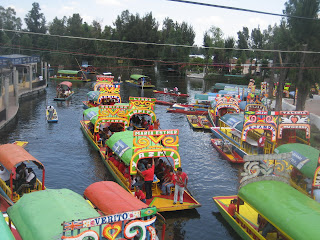
The last day of our exchange, we went for a ride down this canal in Xochimilco

Student´s Personal Spring Break Story

By Lauren Goff Bethel University

Over Spring Break, students from CGE-Mexico traveled to places including Oaxaca, Mexico City, Puerto Vallarta, Cancun, Acapulco, San Diego, and El Salvador. Some students visited Mayan ruins, watched professional cliff divers dive with torches in the night, and one in particular enjoyed U.S. American candy once again in California.

I got the chance to go to Zihuatanejo, Guerrero.

Zihuatanejo is a beautiful town located on the Pacific Coast of Mexico. It is a sweet little city surrounding a beautiful bay with incredible sunsets each night. Fishing boats line up along the northern side of the bay and add charm to the little Mexican city. I came here for Spring Break with my parents, my fiancé and future in-laws. What I loved about Zihuatanejo is that it still seemed like a part of Mexico, whereas many vacation spots here have become tourist areas with high-rise hotels and resorts. Because of this, I was still able to expand my knowledge of Mexican culture while staying in this beautiful city for a week.

Also, I was able to share my experience of Mexico with those I had been describing it to over the past couple of months. My boyfriend (who proposed on the trip and now, fiancé), Ryan, has been studying abroad this semester in Guatemala. We talked about our new cultural experiences together. Ryan was able to point out what differences he saw in Guatemala compared to Mexico. I pointed out the differences of language in Mexico compared to Guatemala and warned Ryan of some common Spanish words he may use that would be inappropriate in Mexico.

Ex: you can say “excitado” in Guatemala describing “excited” but, in Mexico it expresses excitement in a very different context (sexually).

Our parents were impressed with our new Spanish-speaking skills; completely unaware of how bad it actually was(!). It was very interesting for both of us to learn about the cultures we had been living in for the past 2 months. It was also great to share these new cultural experiences with our parents and have them learn more about Mexico.

Zihuat after the setting sun

One of the greatest experiences I had on my trip was talking with the woman who cleaned the condo we rented. Olga made delicious dinners for us and during this time everyone was able to ask to her about life in Zihuatanejo. It was wonderful for me to see my parents so interested in learning more about Olga’s life. What was really cool was seeing my parents trying to speak Spanish with her (successful after assistance from Ryan and I).

These talks with Olga opened up later conversation with my parents and Ryan’s where they asked me more about Mexico. As I was answering, I realized how much I have learned here in Mexico. All of the answers relayed back to what I have seen this semester through speakers in Cuernavaca and my other experiences in Mexico. I have treasured sharing the beautiful parts of Mexico with my parents and future family.

Monday, April 19, 2010

Part 2: Mexican Social Work Students come to Cuernavaca

Continued from last blog post by Rachel Takazawa, St. Olaf College

Also throughout the week we had many speakers and a panel. The panel consisted of three sexually diverse individuals. They advocated for the acceptance of character and the differences each person chooses to live regarding their sexual preferences and diversity. It was a moment in which we heard personal struggles regarding discrimination, prejudices, and frustration. As social workers, I felt we had a chance to hear about the hard moments and how through those experiences they were trying to change society.

Panel on Sexuality

During the week there were good times, great times, and hard times. One hard time was that there was discrimination against some of the UNAM students while they were out in Cuernavaca. This experience was something we wished wouldn’t have happened however it also opened our eyes to the reality of discrimination. We were all affected by this experience and now we strive to work together in order to fight discrimination and racism.

CGE and UNAM Students with Profesors

Both students of UNAM and CGE will keep the knowledge and time we spent together as a learning experience and a way to move forward towards a better relationship between Mexico and the United States.

As Social Workers we have promised to learn from good and bad experiences in order to better situations, to fight against injustice and to work towards social justice and equality.

Mexican Social Work Students Come to Cuernavaca

By Rachel Takazawa
St. Olaf College

......................................

¡Bienvenid@s, estudiantes de la UNAM! Welcome, UNAM students!

Throughout the week of March 22nd to the 26th we (students of CGE-Mexico) were visited by students of UNAM (National Autonomous University of Mexico). UNAM is a public university in D.F. (Mexico City). These UNAM students were Social Work students, here in Cuernavaca to learn about aspects of Social Work in the United States, as well as come to know fellow Social Workers from another country. They were a group of 7 whom, upon arrival made their presence known with pleasant greetings. We as an entire group tossed around yarn in a get-to-know-you game. This was the beginning of a great week and some great relationships.

Class Activity with UNAM student

The first night at dinner the room was buzzing with conversation. People had successfully integrated and Spanish was heard much more than English. The language barrier didn’t keep anyone from having a great time. This intercambio (exchange) was not only great for the two groups but also for those from UNAM b/c most of the 7 didn´t even know each other.

Throughout the week Social Workers from CGE gave the UNAM students presentations on VAWA, Medicaid and ICWA.

VAWA is the Violence Against Women Act, which promotes a better life for domestically abused persons. It provides resources, grants, support, and laws through the federal government.

Medicaid is a health care system that is intended to help provide assistance to persons living below the poverty line in the United States.

ICWA is a program to promote cultural identity of Native American children through adoption laws and court assistance. All three of these were great tools to help create conversation about the similarities and differences between the United States and Mexico.

More Class Activities with the UNAM students

It was interesting to find out that Mexico has shelters and important acts set in place in order to assist persons of domestic abuse. The Mexico system has some advantages in regards to payment of such services, nonetheless, it appears that the United States makes it more accessible. The medical system however, was described to us as more accessible to people here in Mexico. Yet on the other hand the quality of the services are less adequate. On the topic of ICWA, Mexico doesn’t really have a program similar, but there are programs that try to teach people about their indigenous cultures and create a place to perform rituals and ceremonies.

What do you know about VAWA, Medicaid and/or ICWA? How do they affect minority groups?

To Be Continued...

Friday, March 19, 2010

Immigration from Mexico to USA

By Lindsay Hale

Bemidji State University

This week here in Cuernavaca, we had the great opportunity to listen to a variety of speakers, one of them including Giselle Stern-Hernandez [1] who spoke of her struggle as a deportee’s wife. Her father is an Eastern European descendant living in New York and her Mother is a middle-class Mexican woman. Both parents had an income which left them cozy but not wealthy.In 1966 it was a snap to renew her mother’s visa and in 1990, she applied for U.S citizenship.Giselle had always considered herself an American but that image would slightly change when she met Roberto, an undocumented worker from Mexico.

As the relationship progressed and eventually resulted in marriage, Roberto and Giselle would face numerous struggles with immigration, deportation, and acceptance. Roberto and Giselle were married right before the INS (Immigration and Naturalization Services) 245 deadline was placed. Filing these papers did not come at an easy task.

United States Embassy in Mexico

In our visit to the United States Embassy in Mexico City, prices of visas and the time and effort that it takes never came up in any of the conversations we had with the representatives. To me it was perceived as an unanswerable question and was avoided.

Finally after struggle to get through all this they see an INS officer. Giselle handed him every piece of information she had: a marriage certificate, her passport, etc. and they were told that Roberto would not be able to enter the United States for 20 years. “Don’t these documents mean anything?” Giselle watched as her husband was led away in hand cuffs. She was sent home to pack a bag for Roberto, “what do you pack for your husband who is going to be deported, something funny that will make them laugh, or something serious to tell him that you love him?”

“The United States immigration does not work in the complicated areas.” What I took away from our visit to the U.S Embassy regarding immigration was that obtaining a visa was easy and anyone who applies and has the correct paperwork is able to receive a visa. However Giselle and Roberto (like many others) did not experience that in motion. So in reality, much of the information obtained in our visit to Mexico City is not reiterated from life experiences here.

Giselle with CGE-Mexico Director Anita right after monologue

Throughout the monologue that Giselle shared with our group, she generously shared her passion, grief, and anger that have proved to be challenging to her marriage and to fellow Latinos. She revealed points of racism and classism, power and positionality. It was shocking to be pulled in a story such as Giselle’s and be blindsided by reality. This does happen. Applying for a visa is very difficult and time consuming, unlike what the U.S Embassy described to us.

As an American, I feel guilty and angry for the way our government is handling their affairs. So I will leave with a final quote in the hopes that you will reflect on the reality of struggles that many immigrants face. “Who will be next; who in your life will be next; who in this room will be the next deportee’s wife?”

ALSO visit Giselle´s website and BLOG

www.gsternhernandez.com (find out MORE about her monologue!)

http://thedeporteeswife.wordpress.com/

1] Giselle Stern-Hernandez, A Mexican-North American writer and performer of the monologue “The Deportee’s Wife;” www.gsternhernandez.com. Performance in Cuernavaca, Mexico on March 11, 2010.

Thursday, February 25, 2010

Week 4: Visit to Rural Indigenous Village


By Amanda Terwey
Bemidji State University

On Tuesday, February 16 we visited Amatlán de Quetzalcoatl. This is the village where the half-human, half-god Toltec Emperor Quetzalcoatl was born. Arriving there we met with a shaman, an indigenous spiritual leader. He is also a member of the Community Land Council. We began our day with a talk explaining the town of Amatlán. History of the town dates back between 4,000 and 7,000 years based on archeological findings in the mountains.

Where the Ancient Drawings Are

It is a small community with about one thousand inhabitants. The people are at risk, states the indigenous leader, of losing their Nahua language due to outside influences. The community is about fifteen minutes from Tepoztlan, a tourist area. This is just one of the issues the talk brought about. Other issues included land and healthcare.

As a veterinarian the indigenous leader is educated in the area of health. He says through traditions health is a gift, but now healthcare is business. It puts a price on a person’s health. Along with health their land has a price. The idea of communal land is something that needs to be recognized. The indigenous spiritual leader made an excellent point by stating that a person can put a few stones in their pocket but can never pick up and move the land. There is the belief that land is not meant to be bought and sold.

Land is not meant to be bought or sold

As for outside influences coming and moving into the community, that is another issue. They are not against investment, but they are against exploitation. He mentioned of two instances where people have come to live in the community of Amatlan. One was a hotel that had lied of their intentions. They did not involve the people of the community, and were dishonest about the use they would make of the land. The other instance was of a doctor that came to meetings, contributed to the community, and had many community members working in the hospital.

There is a difference between joining a community and contributing to it and “joining” a community and using it for your own greedy purposes.

What was evident of our day with this indigenous leader was his passion. The quote from that day that spoke the most to me was when he was speaking of the Spanish during their conquest of Mexico. Paraphrasing, this is what he said, “When torturing an emperor to discover where the treasure was, the emperor said (before he died) that the greatest treasure was in the heads and hearts of the people.”

Walk to sacred site

From the little time we were able to spend in Amatlán we could feel a sense of community and passion of the people. We were fortunate enough to eat comida (lunch), which consisted of sopes (tortillas with beans, cheese, onions and salsa on top) and then hike to a sacred ground with the indigenous leader as our guide. We were able to experience a partial indigenous spiritual ceremony. We learned of many things during our time in Amatlán, and from listening to a wise passionate man.

Friday, February 19, 2010

Week 5: Students Go on Excursion to a Palace!

By Alex Peterson
Bethel University

This past week we had the opportunity to visit and view a mural depicting, the history of Morelos, the conquest, and the revolution, portrayed by Diego Rivera. Diego Rivera was a famous painter throughout the world who established his name by painting murals in places such as: Mexico City, Chapingo, Cuernavaca, San Francisco, Detroit, and New York City. The particular mural that we saw at the Palacio de Cortes (Cortes´Palace) in downtown Cuernavaca was based off of the battle between the Aztecs and the Spanish. We spent about an hour analyzing the mural, which wrapped around an entire upper room of the museum.

Indigenous slaves under the Spanish rule

There was quite a lot to be said about Rivera’s depiction of this major historical event. Before getting to the museum we had a brief lecture by one of our teachers refreshing our minds of what had happened during the conquest of Mexico. As we spent the day discussing this event I came to realize that primary and secondary education in the United States of America did not clearly and concisely depict everything that the Spanish put the indigenous people through.
Another part of Diego´s mural

The mural painted by Rivera showed the absolute control that Hernan Cortes (a Spanish conqueror of Mexico) took over the Aztecs and indigenous people. Rivera´s depiction of Cortes throughout the mural was of someone who stood above the rest. He was illustrated standing above indigenous Aztec people who were being tortured in very inhumane ways, such as the pulling or stretching of the body or the scalping of the heads.


Also portrayed was Cortes’ infamous translator, advisor, and mistress La Malinche, who was an important indigenous woman, caught between the two worlds. There is quite a bit of controversy surrounding the relationship between these two, and for some she has become the symbol of betrayal in Mexico. Hernan Cortes´ and La Malinche’s son was considered the first-born “Mestizo”. Mestizos are people that share both European and Indigenous Mexican ancestors.

Tuesday, February 2, 2010

Social Work Semester in Mexico Begins Again!

By Christina Olson
CGE-Mexico Intern

It has been 8 months since the last year´s Social Work students left Cuernavaca, México. They went home and/or back to their colleges and universities, enriched by all the travels and people they met here. Now that they have gone and continued their work elsewhere (yet many keeping in touch with each other), it is time for this new group of 11 Social Work students to embark on their studies in Mexico, together with their fellow "Migration and Globablization" semester students.
The Ex-Hacienda Santa Cruz Where We had an Orientation "Retreat" Overnight!

The first week is full of orienting the students to Cuernavaca, and also to another culture and context. We all went to the Xochicalco pyramids and to a beautiful historic ex-hacienda (former sugar cane plantation) and spent two days getting to know each other better and doing activities and interactive sessions. One session was called the "Fish Bowl." In this session four people sat in the middle of a circle of about 10 others. The four in the middle had to discuss the article for this particular session.

Social Work and Migration/Globalization Students Doing the "Fish Bowl"

"The "Fish Bowl" was the perfect activity to use to discuss the controversial article "To Hell With Good Intentions" in which Ivan Illich told a group of volunteers from the U.S.A. NOT to come to Mexico to impose themselves on Mexicans since they couldn't help but be cultural imperialists for the middle-class U.S. way of life. As you can imagine, the article generated a lot of good reflection. Have you read the article? If so, what do you think of what Illich says? (If you haven't, you can look it up on line.) What do you think the appropriate role of foreigners is when it comes to trying to "help" others? In what ways do people need to be careful about not imposing our own cultural values or reinscribing stereotypes?

While at the Ex-Hacienda, we also talked about Peggy McIntosh's famous article "White Privilege: Unpacking the Invisible Knapsack," as well as articles on the privileges awarded us as U.S. citizens and heterosexual privilege. Have you reflected upon your own privileges much? Perhaps the most inspiring article was "The Complexity of Identity: 'Who Am I'?"" by Beverly Tatum, in which she concludes:

"To the extent that one can draw on one's own experience of subordination - as a young person, as a person with a disability, as someone who grew up poor, as a woman - it may be easier to make meaning of another targeted group's experience. For those readers who are targeted by racism and are angered by the obliviousness of Whites, it may be useful to attend to your experience of dominance where you may find it - as a heterosexual, as an able-bodied person, as a Christian, as a man - and consider what systems of privilege you may be overlooking. The task of resisting our own oppression does not relieve us of the responsibility of acknowledging our complicity in the oppression of others. Our ongoing examination of who we are in our full humanity, embracing all of our identities, creates the possibility of building alliances that may ultimately free us all."

Do you agree with Tatum? Why or why not? What do you find helpful or unhelpful in what she says and in the article by McIntosh? We look forward to hearing from you as we embark on our new semester in Mexico!